


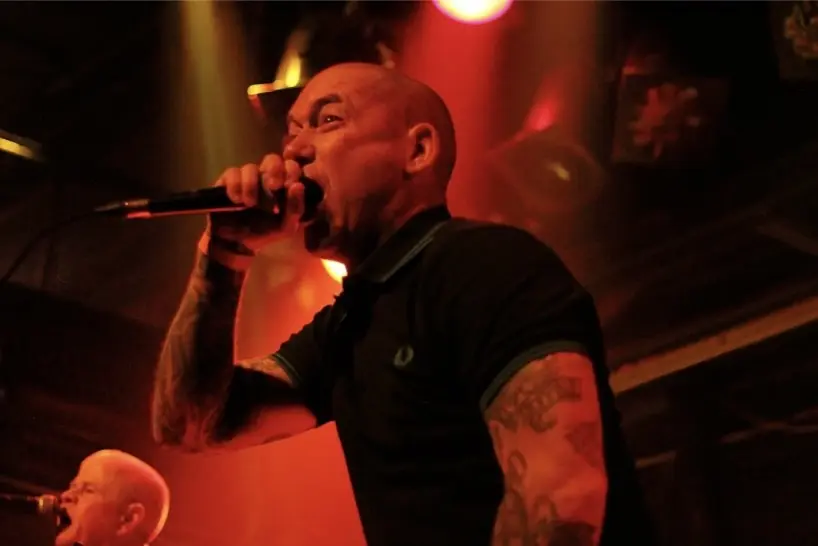
Toledo Panic may be one of the newer names on the American Oi! and streetpunk scene, but the story behind the band goes back much further than its formation. Martin has more than four decades in the punk scene under his belt, while Jagger returned to the microphone after spending more than ten years away from bands. Together, they draw on years of experience in the California underground, combining Oi!, streetpunk and a strong DIY attitude. We talked about their paths into the scene, old-school Los Angeles and the Bay Area, the changes brought by social media, vinyl records, keeping the underground alive, and their upcoming European tour. You can also read our review of their debut LP Till The Work Is Done.

To start with – Toledo Panic are still a relatively new band, but you’ve already attracted a lot of attention. How did the band come together, and what inspired you to start it?
Martin: I had always wanted to start a proper Oi! band, but as I live in a small town with just a couple skinheads I had no one to front the band. Once I met Jagger who I found out lived in town and I knew previously fronted for Nuts & Bolts, I knew I found my frontman!
Jagger: Yes, Martin ruined my plan of anonymity and pulled me back into the wild world of playing in a band again. I hadn’t been in a band for over 10 years and didn’t really think I ever would again. It made too much sense after meeting Martin and us both living in a smaller town. We share most of the same influences and had a lot of the same goals and ambitions for starting a band. I feel if you have two or more Skinheads in a small town you are almost required to start a band!
Before Toledo Panic, what were your personal journeys into punk, Oi!, hardcore, or the skinhead and streetpunk subculture? What first pulled you into this world?
Martin: Back in high school in 1985 or so, I started going to punk shows and started seeing skinheads there, as well as saw skinheads at a soul/ska club in Hollywood. The more I learned about the subculture, the more I wanted to be a part of it.
Jagger: I grew up in Miami, Fl. There wasn’t a huge punk scene there and it took a lot for bands to come to Miami, because they really had no way out but back the same way they came. So a lot of bands didn’t even bother. The first time I ever saw skinheads was at a Sick Of It All show at the Kitchen club in the Grove. They definitely peaked my interest and I started learning about what it was all about. Then I saw The Business play at a small club in Miami in the mid ninties and I was hooked. I moved out to the Bay area in California for my senior year of high school in the late 90’s. All the local bands of the time were the best in my opinion. Most all touring bands make a stop in the bay area, so I was privileged to be exposed to all the best bands in the world at the most influential age of my life.
Growing up in Southern California, what was your local scene like? Which venues, bands, or people had the biggest influence on you?
Martin: Over 40 years, I have seen lots of change. Early on there were gangs of skinheads at a place called Fenders, but there was also Geno’s in Hollywood that was mostly reggae/soul skinheads, rather than the more punk/Oi! skinheads. There were a couple good clubs in Long Beach called Jets and Grand Central Station that had DJs spinning classic ska, reggae, rocksteady, and soul which resulted in a tight and growing scene.
Jagger: I was up in the Bay area. We had some amazing bands going when I was there, Reducers S.F., Workin’ Stiffs, United Blood, Swingin’ Utters, One Man Army. Orlando Xavier of Special Forces, United Blood, and Intrepid A.A.F. was a huge influence on me. As an older skinhead he took me under his wing and showed me the way. He also was the first singer I had seen that really inspired me to want to sing in a band and try and put out the same energy he had on stage myself. We had some great venues going. The Pound in S.F. was especially memorable as it was off in the middle of nowhere and always had an apocalyptic do what you want feel out there. Of course there was Gilman St. in Berkeley which was always a struggle dealing with security and us poorly trying to follow the rules. I also loved the Cocodrie in North Beach, S.F. I saw many classic bands there. They would have all age matinees in the day and then 21+ shows at night. I would go for the matinees when I was underage, hide in the bathroom between shows and then sneak out to go to the 21+ show. Great spot, I would head up the street to the arcade between bands and play a couple of games of pinball before heading back, I miss that spot.
California has a long and unique punk history. How do you see yourselves fitting into that tradition? Do you feel connected to the earlier generations of bands from your area?
Martin: I feel connected as I was part of it, ha ha, I had a skinhead band called Headstrong that I fronted. And played guitar in an Oi band called Lion’s Pride. Although musically it is a little different, as I was just a teen then and now have years of music appreciation driving my song writing.
Jagger: I think in our direct area of Ventura/Oxnard we don’t really fit in, but are accepted and appreciated. Historically most of the bands from this area are way more thrashy and faster than us. I do feel we don’t fully connect musically with the local bands/scene but we can all connect over our universal love of beer and having a good time and getting some aggression out.
Your music combines Oi! And streetpunk in a very natural way. Was that always the vision, or did your sound develop organically once you started writing together?
Martin: Thanks for that. I think it’s just my love of both of those genres. I think in most of my past bands as well, I have taken a little bit from many punk genres and merged them.
Jagger: Vocally I am influenced by so many different bands and genres that it’s always hard to really pinpoint what I want the music I make to sound like. I usually just go with what naturally comes out from feeling the music. I will try and manipulate some songs to sound one way or another, but for the most part I like to just let things roll and hopefully it sticks.
Your lyrics often revolve around working-class life, loyalty, frustration, and everyday struggles. Where do those themes come from? Are they based on personal experience, observations, or both?
Jagger: I definitely pull my lyrics from my daily life. I work a lot, I travel a lot, and I always seem to be frustrated with something. The best release I can think of is writing songs that I get to perform live and let out all my frustrations with the world around me. I try not to write about things that are too big, too political, or use too many big words. I’m pretty simple and I get frustrated very easily so I want to pass that frustration on to you, you’re welcome.
What does the Oi! subculture mean to you today? Is it mainly about music, or does it still represent a way of looking at life?
Martin: Seems as there are many sub-genres of Oi! now that there are a variety of people embracing it, so maybe less a way of life and more a passion for the music?
Jagger: It will always be about more than a style of music to me. It’s about standing against racism and being able to walk with pride in yourself with a strong work ethic. The music is just a way to unite us and get a message across. It’s knowing when you see another skinhead walking down the street or at a show, you know they have mostly the same beliefs as you and you know that you can have a beer with them and not want to strangle them.
Looking back, what did becoming part of the scene mean to you when you were younger? And what does it mean today? How important is the DIY spirit in your lives?
Martin: Definitely when I was younger it was more of a brotherhood, running the streets with your friends. Now it is still embracing your friendships, just hanging in pubs, going to or playing shows, and not so much running in the streets, haha.
Jagger: It meant everything to me. A sense of belonging and as Martin said a brotherhood is what I was missing in my life at that young age. Being surrounded by so many older influential people from the scene in the Bay area really opened my eyes and let me see a future I didn’t know existed before.
D.I.Y. is everything. I do everything I can myself, or I learn how to do it. I’ve always tried to do things myself first and secondly go to the experts. I find it important that if you can’t do something yourself, try and learn it, or at the very least go support someone else who is doing it for themselves before giving in. I think it is a huge trait that distinguishes our underground scenes from the shitty mainstream.
The American Oi! scene has had its ups and downs over the decades. How do you see its history? Which bands or moments do you consider the most important in shaping where the scene is today?
Martin: For me, maybe first time I heard Anti-Heroes that was a big influence on me and probably loads of others, Reducers SF another for California, There is definitely a re-birth of Oi! as of late.
Jagger: Growing up, almost all American skinheads I knew would have an American flag on them somewhere. Now it’s almost never seen, or you have to be prepared to be lumped in with the Trumpers if you wear one. I do think about it often, it is hard to be a proud American at this time, but I think you can have pride in your country or where you are from and not agree with all of the actions of your country. That is the best part of being an American and why this country was founded. I think a lot of the earlier U.S. bands were more conservative in their beliefs, whereas now the bands are all over the place. Times change, the U.S. and the world is a much different place then it was in the eighties and nineties.
Do you think young people enter the punk and Oi! scene differently today than previous generations did? What has changed the most?
Martin: It’s definitely different. You had to work hard to find bands, find the music, and learn about the subculture. Like with everything else the internet offers all the music and content you have the time to absorb. So they are definitely better educated then I was when I first got into it.
Jagger: Yes, it’s definitely easier and more accessible. But I do think if it is something that hits you the right way and you feel it in your heart you will pass the test of time. The ones who shouldn’t be part of the punk or skinhead scene always find a way of weeding themselves out.

How has your own perspective on the subculture changed over the years? Are there opinions you once held strongly that you’ve since reconsidered?
Martin: Nothing comes to mind, other than I don’t think it is as cool to chant “skinhead skinhead” at shows anymore, haha
Jagger: I’ve found myself being more of a loner rather than always running with a crew. I used to stick with my crew of friends and not venture out as much as I probably should. I think I have become more confident in myself as a person and less reliant on my friends, mostly because we’re all older now and we all live scattered about the world.
Authenticity has always been an important value in punk. What does being authentic mean to you in 2026?
Martin: Still supporting the scene, supporting your friends, and contributing to keeping it going.
Do you think it’s becoming harder to distinguish between people who genuinely live the culture and those who simply adopt the look?
Martin: As I live in a small town, only time I see skinheads I don’t know would be when I go in to Los Angeles. So not really sure who these people are all about. Maybe at a punk show some may be more about adopting a look, whereas if I am at an Oi or Rocksteady type show they are probably living it.
Jagger: Who am I to judge anyone from their looks or their clothing. I think people contribute to the scene in many different ways. Like I said before the people who don’t belong or are in it for the wrong reasons always find a way of weeding themselves out.
What differences do you see between the underground scene before social media and today’s scene? What has been gained, and what has been lost?
Martin: It is certainly easier now to connect with other bands and promoters. I do all of our bookings, I would have never known how to get a US East Coast or European tour booked. Also people can find our music much easier. Have friends across the world now. Not sure what has been lost other than before I thought I was part of a small and special subculture, where now it’s a much bigger thing and maybe doesn’t feel as special??
Jagger: I do miss talking on the phone. I think social media and texting has really removed the human aspect of communication. There’s something about hearing someone laugh or cry rather than seeing an emoji. I understand this is how it works today and it will be in the future, but please don’t be scared if I call you on the phone and want to know its you.
Being in a band used to be about writing songs, playing shows, album covers, and stickers and flyers. Now you have to have this whole new layer of social media skills that most of us, especially the older bands are not good at. Instant gratification and validation from social media can sometimes kill the soul of what you are doing. Swipe right, on to the next post before you really even processed what you just saw.
What’s your relationship with streaming services like Spotify or Apple Music? Are they a useful tool for independent bands, or do they undermine the DIY ethic?
Martin: I love to get our music out there, so I think it is great. We played out in Montreal and I was seeing people sing along with our songs, so they clearly found the music online. Also, labels are hard to get on, so Spotify offers an opportunity to not rely on labels and make your music available everywhere.
Jagger: I love Apple Music, I use it daily. I mostly use it as a research tool to find new bands and hear stuff I didn’t know existed. I do make it a point to purchase physical copies of stuff I like from bands I hear on Itunes.

And what about social media? Could a new band realistically build itself today without Instagram or similar platforms? Has social media ultimately helped or harmed underground music?
Martin: Social media I am sure has helped us get to where we are. Even though we are not good at doing all that social media promotions, it’s a good way for people to find out where we are playing and if we are releasing new material.
Jagger: New world new ways. I think you have to adapt to the way the world works these days. I think overall social media is a great tool for underground bands. It’s made great music and messages accessible to everyone in the world that may not have ever been heard. I think that’s a good thing, how many hours a day you spend scrolling and watching bum fight videos is your own moral dilemma.
Do you ever feel that the modern world is overloaded with content? Has the constant fight for attention made it harder for meaningful music and ideas to stand out?
Martin: There are a lot of bands out there, so yes it does make it hard to stand out. But I think it is great that people are out there doing it, putting out music and keeping the sound alive and kicking.
Jagger: The cream always rises to the top. If you are good enough and work hard at whatever your goal is you can make it happen.
The internet has made music instantly available, but has it also taken away some of the excitement of discovering bands through record stores, fanzines, tape trading, or word of mouth?
Martin: I can hear about a band via word of mouth, or read about them and I can check them out in seconds. So I like it. Also, if at a record store I can see a record and listen to a song or two and then decide if it’s worth it to buy.
Jagger: I do miss the treasure hunt a bit. I miss not knowing something about a band, but knowing who in my rolodex of friends would have the info I needed. Now my best friend is the internet and he knows everything. Whether to believe him or not is up to you.

What role do physical records still play in your lives? Are vinyl and CDs still essential parts of the culture, or have they become collectors‘ items?
Martin: I still collect vinyl. But for others I think some do and some don’t, but I wouldn’t hold it against anyone if that is not their thing. Especially younger people as it was never part of their life growing up like it was with me. That is all we had, records and sharing your music with others via cassette tapes.
Jagger: Vinyl is everything in my life. My vacations are always judged on what records I came home with. I book all my hotels based on where the record stores are. I love owning, smelling, feeling the records in my hands. I love looking at all the extra stuff you get in the physical media that you don’t get online. The artwork, the thank you’s, the fuck you’s, the pictures of the band. I love seeing how things are laid out, what new and interesting ideas did the band come up with for the release. I love sharing my collection with people who come over to the house, flipping through my collection to play them something new or something old they might not know about. “Hey check this out, this is Cock Sparrer before they were called Cock Sparrer.”
You released your music in an era where anyone can upload an album online within minutes. Does that make it easier to be heard, or does it simply create more noise?
Martin: We definitely would not be where we are without an online presence, there is just a lot to compete with. You are just hopeful you have a sound that stands out a bit from the rest.
Jagger: It does make it easier to be heard, but because of the ease of uploading music to the web it does create a very large pot to have to sift through. I think people have their own ways of finding what they want and good music will always find its audience one way or the other. Music online is a great place to get lost and stumble upon something you may never have given a chance if you had to pay for it.
Live shows have always been the heart of punk. What do concerts mean to Toledo Panic? Is the stage where the band truly comes alive?
Martin: I definitely think we shine on stage, as Jagger is a good frontman. But I think the music has to be good enough to get people to the show to experience us live.
Jagger: Thanks Martin! I really do like to play live. Seeing a band live is really when the power and passion can be properly translated. You have to be in a room with a band to really feel them. It’s especially why I have always enjoyed small punk shows in shitty small bars. It’s one of the greatest things about the underground music scene. You can be sitting at the bar talking to someone one minute, then the next minute that same person is up on stage giving all they have to you and the other 10 people there. You can never get that personal connection from a recording or from a large mainstream concert. For me, once I see a band live and then go back and listen to their records I have a totally different understanding of the band, their music, and their message. Hopefully you leave a Toledo Panic show energized and ready to take on the world!
This autumn you’ll be heading to Europe for your biggest tour so far. What does that opportunity mean to you? Which countries, cities, or festivals are you especially looking forward to, and what differences do you expect between American and European audiences?
Martin: I cannot wait for this tour. October 15-24 We are playing Paris,Dijon, Leistal, Mainz, Karlsruhe,Kassel, Dresden, Berlin, and Munich (in that order). Pogorauch festival in Dresden was and is our anchor show, which I am most looking forward to, but all of them I am sure will be great. Differences I hope will be that people come out, as it is hard to get people out in the States.
Jagger: Playing Europe is something I didn’t do in my old band Nuts and Bolts. So playing Europe was a big goal for me in Toledo Panic. Just like playing anywhere, I look forward to meeting new people and having fun! I like to observe how other people from around the world live and hear about their struggles and what is different in their daily lives compared to what Americans deal with. I also like seeing and meeting new bands I may have not heard of. I’m especially looking forward to playing with Bonecrusher in Berlin Wild at Heart. I think that is going to be great show!

Has being in Toledo Panic already given you experiences that you would never have had otherwise? A place, a friendship, or a moment you’ll never forget?
Martin: All of our out of town shows have been great, meeting new people and new bands. Montreal for the Oi Festival was a monumental show for us, sharing the stage with legends like The Last Resort and Newtown Neurotics and a handful of amazing new bands.
Jagger: I’ve toured and worked in the music industry for a long time, so I have seen and experienced a lot of the typical things you see in the states. But playing in Toledo Panic I will now get to do all of those things in new countries with new people. I’m very excited for that and can’t wait to try real Swiss cheese!
Every band has its stories. Is there one show that was complete chaos but has become one of your favourite memories?
Martin: Playing down in Mexicali with Kaleko Urdangak was a bit of chaos as our bass player couldn’t be there, so we had our guitarist fill in last minute and sound on stage was a nightmare, but we got through it and had a great time.
Jagger: Not to mention it was 100 degrees at 10pm on the outside stage! Luckily the beers in Mexico are very large and very cold.
On the other hand, has there ever been a point where things became so difficult that you questioned whether the band should continue?
Martin: I am dedicated to making this band work. Biggest challenge has been to find members when we were first getting started, but we got a solid line up now.
Jagger: I don’t really find it difficult to play in a band. As long as we can prioritize the proper time to make the band work. And everyone is on the same page with what we want out of the band. Then I think we should continue.
How does Toledo Panic function internally? Are you simply bandmates, or have you become something closer to a family over time?
Martin: I think with a band you have to be more than bandmates, as we are spending time together at rehearsal, on the road to gigs, traveling internationally you want to be surrounded by people you like to spend time with.
Jagger: We have gotten to know each other through the band. I think we are all still learning each others quirks and how to handle them. But the process of being in a band brings you very close to your bandmates. It’s like having a second or third wife. I’m still working on not pissing off my first wife by spending too much time with my band.
Are there any current bands or labels that excite you? We’d love to hear your recommendations—not only within punk and Oi!, but also outside those genres.
Martin: Longshot and Contra put out a lot of great bands. Lawmaker I really enjoy for a newer band.
Jagger: I like what Brute Squad records is doing with his Distro and putting out some newer bands. Also, Street Rats Records has been finding some great new bands and rereleasing some great records that never had a proper vinyl release. You can’t go wrong with pretty much anything on Lionheart, Mendeku, or Randale. There’s so many great labels and participants to this scene that keep everything rolling. There’s too many great newer bands to name, your best bet is to go listen to Stay Rude Radio, Spanky plays all the great new bands there! I do appreciate that there are still bands going that I used to play shows with when I was playing in Nuts and Bolts 15 years ago, like Strongarm and the Bullies and Blue Collar Criminals. It’s pretty awesome to connect with those guys again.
What do you personally listen to when you’re not listening to punk or hardcore? Are there any artists that might surprise your fans?
Martin: I listen to a lot of Jamaican music and some soul. Growing up in the 80’s new wave is still something I enjoy. I can jump from Slayer to Billie Holiday, to NWA, to Hank Williams Sr.. Lots of great music out there.
Jagger: I listen to all kinds of other music. By far my favorite non punk artist has always been Tom Waits. His music was the first I heard that really captured me. Of course I was required to listen to and love the Rolling Stones with a name like Jagger.
How do you see the current global Oi! and streetpunk scene? Do you feel that bands around the world are more connected today than ever before?
Martin: For sure, it’s so easy now to make contact with bands and try and make things happen.
Have you built friendships with bands in Europe or elsewhere that you’d probably never have met without music?
Martin: Yes with each band we have played with that we liked, we stay in contact and try and play with them again. I made many contacts when I was playing with Doug and Slugz which has helped get Toledo Panic to move forward. Also bands like Scunthorpe Yobs who after our first show together, we always try and hook them up with shows and they do that for us. I imagine on our European tour we will do the same, as we will be doing a lot of shows with The Clinch from Australia. I am sure we will become good friends by the end of the tour.
Jagger: Ya, I hope The Clinch like to drink beer!
Looking at today’s audience, do you think concert crowds have changed over the last ten or fifteen years? Is new blood coming into the scene while older generations remain involved?
Martin: I don’t see too many younger kids coming in at the shows I go to, with mostly just older die-hards, but I hear they are out there, maybe just supporting other bands or shows..?
Jagger: There are definitely young kids out there, but the problem is finding the all ages venues. I have a hard time going to shows without being able to drink…maybe I have a problem, I don’t know.
Do you think the scene still feels like a genuine community, or has it become fragmented into smaller groups and online bubbles?
Martin: It was definitely a community in the early 90’s for me in Los Angeles, as there was only one club doing events, we all were there and we all became a family. Now there are shows and reggae DJ nights all over Los Angeles, so people are spread out and may stick closer to home
Jagger: There are so many other things you can do nowadays that don’t involve going to a show or event within the scene that it may fragment the scene a bit. You can do so much from the comforts of your home that it sometimes makes it hard to go out and contribute to the scene. Not to mention it’s pretty expensive these days to go out. Ticket prices, gas, merch, drinks, food, etc. can make it a hard decision to leave the house. The online presence of bands and shows can sometimes lead to a false feeling of “I was there” when really you just saw a video on your phone. But that usually leads to a jealous feeling of wishing you were there and hopefully that pushes people to the shows next time.
If someone had never heard Toledo Panic before, which record would you recommend they start with, and why? How do you see the band’s musical evolution so far?
Martin: So far we only have the one LP. In the process of writing a new record, be interesting to see how it comes out and how our sound has evolved or if it is still in the same pocket as our first record.
You’ve already worked with independent labels to release your music. How important have labels been to Toledo Panic’s journey? Who have you worked with, and what have those collaborations been like?
Martin: Lionheart Records put out our record. Christian was super easy and great to work with. The only challenge has been that it is pricy to have records shipped overseas. So I imagine some folks that would like a record would just settle for downloading on bandcamp or listen online rather than paying the high shipping costs.
Finally, the last words are yours. Is there anything you’d like to say that we didn’t ask about? The floor is yours.
Martin: It’s been a long road for me playing music. 40 years of bands that didn’t really get to where I want to be. Now the time has finally arrived, hope people come out to see us in October
Jagger: Thank you for showing interest in us and giving us the opportunity to let anyone out there who wanted to know a little more about Toledo Panic the chance to hear it from us. I can’t wait to awkwardly and intensely stare deep into all of your eyes while I’m singing out in Europe! Now quit being lazy and go to work!
DISCOGRAPHY:
Till The Work Is Done LP (Lionheart Records, 2026)

