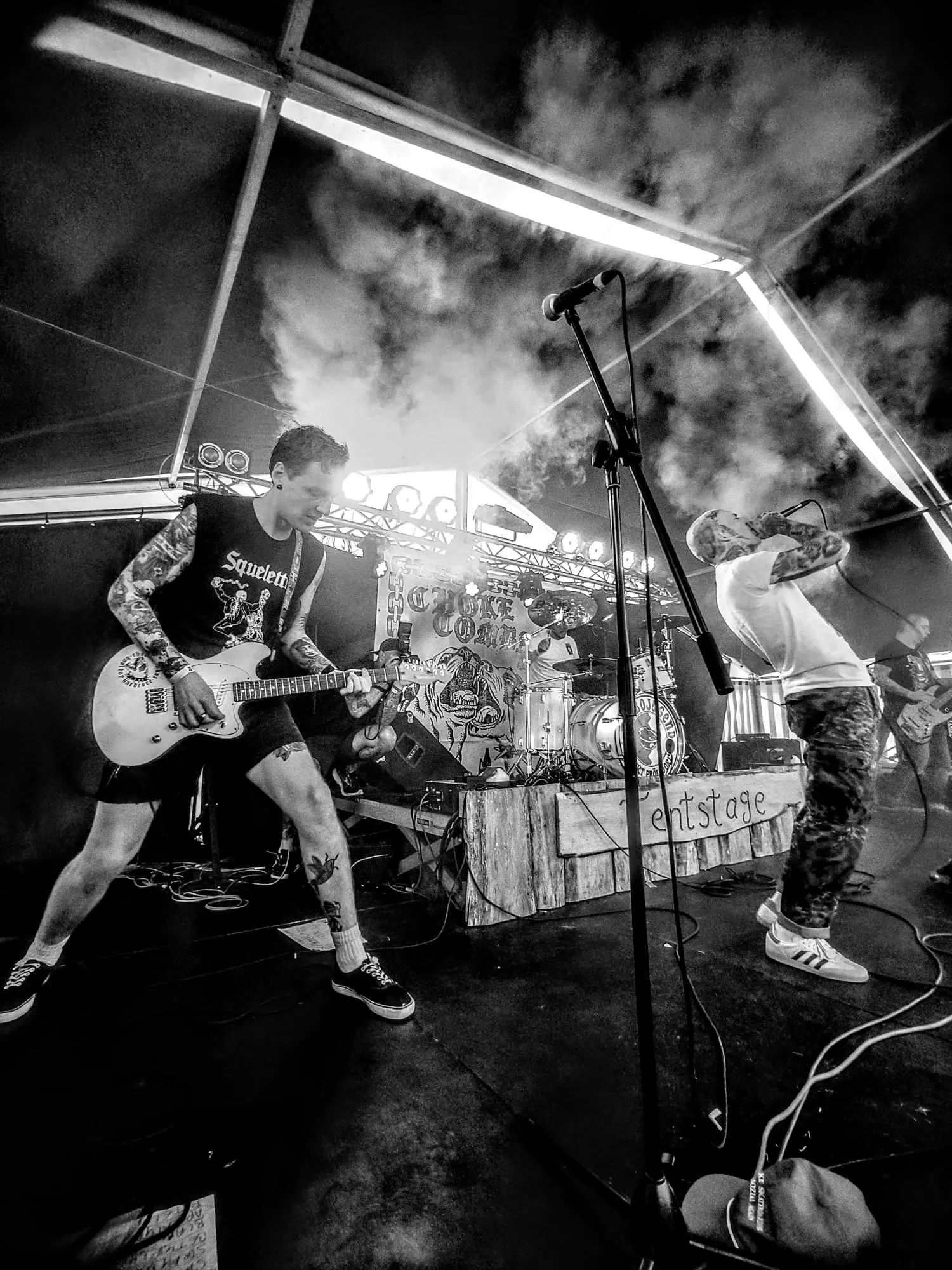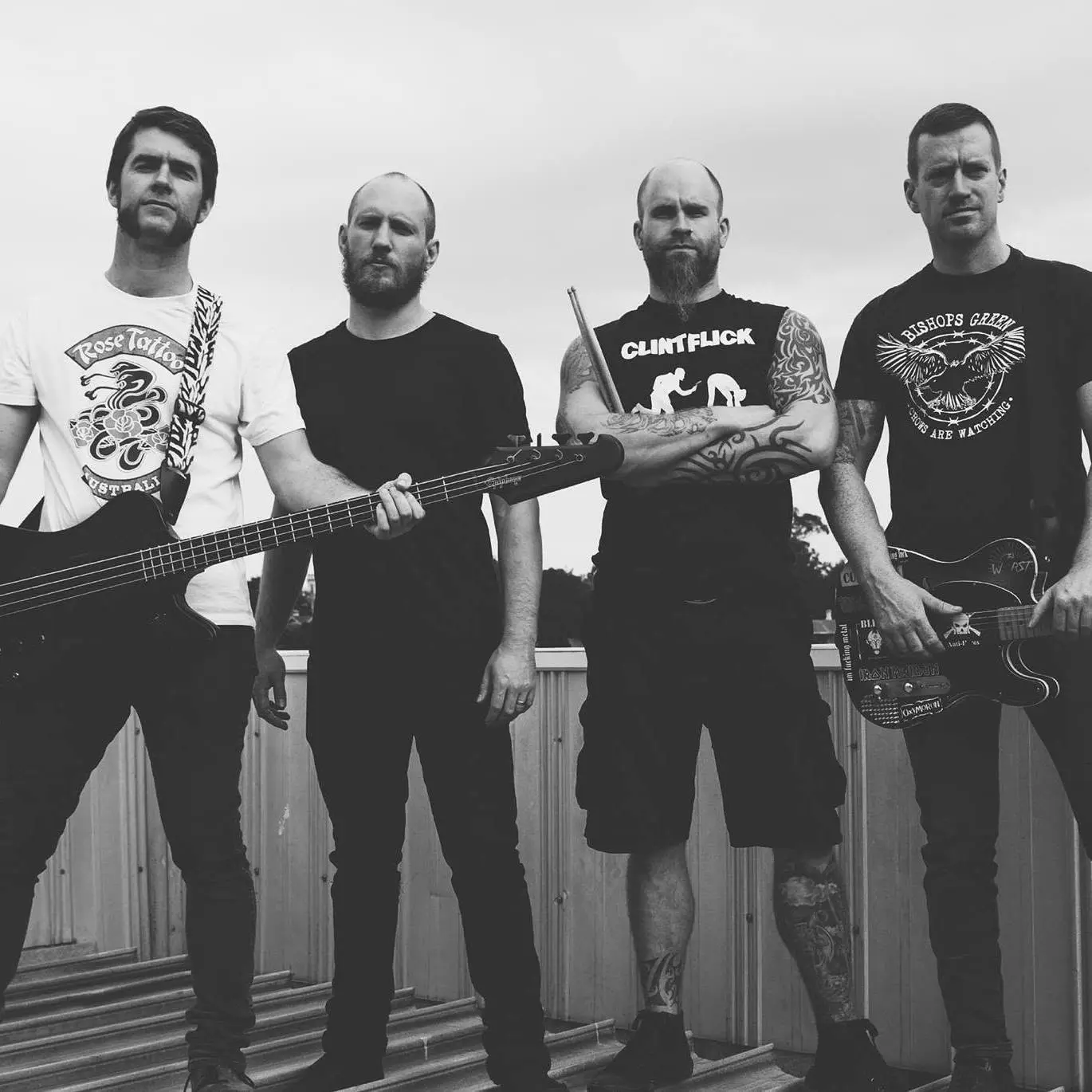
Australian band The Clinch are no strangers to the pages of Tighten Up. The Melbourne crew have been operating somewhere between Oi!, streetpunk and good old rock’n’roll for quite a while now, and this year they are back with their third album, Time’s Up. It might be a little darker and more personal than their previous records, but it still has everything you would expect from The Clinch – strong choruses, melodies, pub energy and lyrics about life, friendship, getting older, loss, struggle and refusing to give up.
This time, we spent a lot of time digging into the lyrics. But we also talked about the beginnings of the band, Melbourne and its punk scene, combat sports, existential dread, dogs in bomber jackets, Sisyphus, ninjas, kebabs, recording-session benders and, of course, the new album Time’s Up. The result is one of the longest interviews we’ve done for Tighten Up in quite some time, and a pretty good look at what lies behind the music of The Clinch.
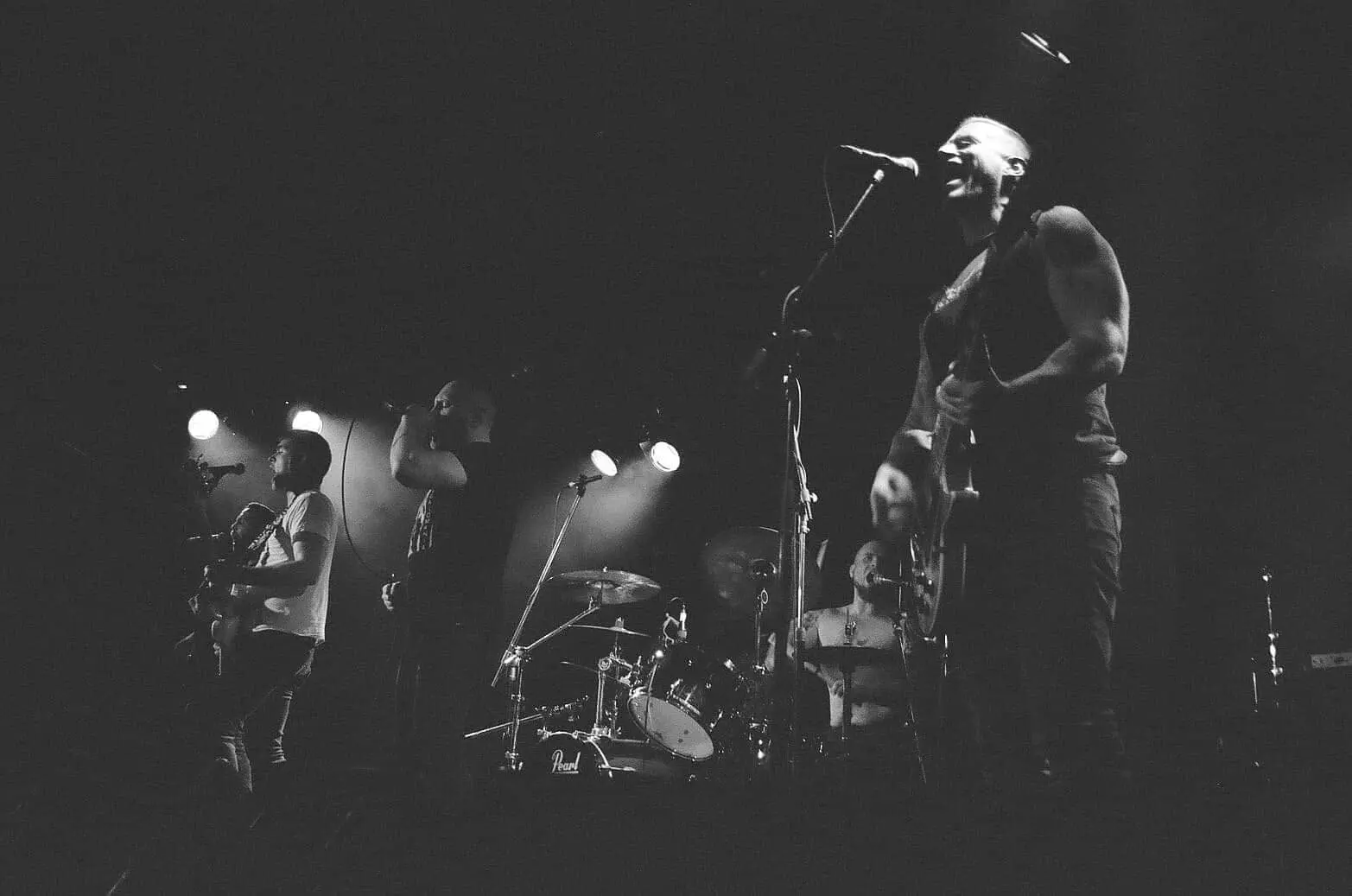
And the timing couldn’t be better. In the coming weeks, The Clinch will be heading to Europe for the first time, playing a run of shows alongside bands like The Last Resort, Bonecrusher and Toledo Panic. After their first attempt at a European tour was killed off by Covid, they are finally making it over to our side of the world.
So put on Time’s Up, read the interview and, most importantly, if The Clinch are playing anywhere within reach, get off your arse and go support them. Judging by the answers below, they’re a bunch of good blokes you can grab a beer with after the show and talk about music, life and all kinds of shit.
The Clinch are finally on their way to Europe. Let’s give them a proper welcome.
The Clinch are: Steve: singer; Brendan: bass; Luke: guitar; Andy: guitar; Sammy: drums.
The Clinch have been around for a few years now, and Time’s Up is your third album. When you look back at the beginning of the band, do The Clinch still feel like the same band you started all those years ago, or have you changed significantly along the way?
Brendan: Same band I reckon. We added Andy along the way which was an actual change, but we started this one when we were all in our thirties so not as much room to move compared if you started as teenagers. Somehow we are all slightly more fucked in the head, but the core of who we are and why we are doing it are the same.
Luke: Changed along the way in terms of song writing. We started as a four piece Oi! band but have grown significantly as we added members and improved as musicians. We hold the same values and are still a bunch of loose units though.
What was the main impulse behind starting The Clinch in the first place? Was it a long-term dream of being in a band, or more a need to say something and create your own band within the Melbourne scene?
Luke: Me and Steve have been close mates since we were 16 years old and always been involved in the punk/Oi! scene in Melbourne. Many drunken nights we spoke of starting an Oi! band and on monday after a big weekend I finally booked a rehearsal room for the 2 of us. Soon after I recruited Sammy on drums followed later by Brendan and finally Andy a couple of years later.
Brendan: I just wanted to be cool and get the drinks rider and free entry to gigs! I thought Luke actually wanted me to play guitar when he asked me to join. When I asked if he thought I was good enough on guitar, he said ‘you’re playing bass cunt’. Which as a shit guitarist has turned out to be a bit of a relief, as while bass is a bit lame its heaps easier.
Steve: Bass is only lame the way you play it mate. Rock n roll ain’t worth the name if it don’t make you strutt.
What still makes you want to write new songs and play shows after all these years? What is the reason that makes it worth all the time and energy you put into it?
Brendan: A reason to be at the pub is a big driver. I actually like seeing all the other bits that people contribute, like flyer artwork, zines and reviews, cool photography, doing sound at gigs, making film clips, etc. That there are a lot of people contributing to one kind of thing in their own way is pretty cool.
Steve: For me, whether or not I am regularly picking up the guitar is a good gauge for how stressed or happy I am. When I’m doing better in life I tend to be more inspired to write. I think other people might write to express and process more difficult things, or to vent, or because they are angry about something or see some injustice, but for me it mostly comes spontaneously when I’m relaxed.
Luke: I love writing music. There’s a moment when it comes together that is hard to beat. But more than anything I love the brotherhood.
What do you think is at the heart of The Clinch’s identity? Is there something that has to be present in every song for it to still feel like “The Clinch”?
Luke: Big balls, tiny penis
Brendan: Can’t argue with that!
When you listen to your earliest recordings today, what do you still like about them, and what would you do completely differently now?
Steve: There’s some things that have always felt unfinished about a few of the songs on each album that I wish we had spent a bit more time on, or been more open to trying at the time, but I think each album has its place, and there’s a certain charm to the more stripped back earlier stuff. I think some of the best songs from the albums are overlooked by the algorithm, as people often start from track 1, so it boosts the early tracks and that is self-reinforcing. It’s crazy to be releasing albums now from a digital and audience building perspective, as you get much more attention single by single, but we still love the format so everyone can F.O.
Brendan: I love the first two albums, but it’s also really clear when I listen we have gotten better along the way. That each one had a bit more thinking behind it, a bit more time to get it right, to add in bits of production. I still don’t think any of them capture the gang vocals like we do them live, gotta finally get that right one day!
Luke: I love our early demos. We have almost an album of unreleased shit recorded on phones etc… To me they sound great, capturing the LOFI dreams of a bunch of peanuts.
Andy: They were shit until I got here!
Did you have a clear idea from the beginning of where you wanted to go musically, or did The Clinch’s sound develop gradually according to whatever you were into at the time?
Luke: Yeah we wanted straight up Oi! band but it never comes out how ya want. I pretty much only listen to punk, Oi!, metal and it is what it is. Once we got Andy in the band, someone who can actually play we tuned in to some rock n roll.
Time’s Up comes six years after Basecamp. What changed in your lives and within the band during that long period, and how much of that found its way onto the new album?
Steve: My life has changed a lot as I did night classes over many years to study a law degree and finished it around the time Basecamp came out. So, I started a whole new career. I now work in litigation, primarily in employment law, and it’s quite demanding. I don’t think that’s really affected my song writing as, on a more fundamental level, and where the songs come from, I don’t really identify with my job that much compared to other things.
Luke: I wrote the majority of music not long after Basecamp but tackled things like covid and members having kids etc.
Andy: Had a kid, bought a house, changed jobs, full kit and kaboodle.
When did you first realize that you had enough material for a new album? Did the songs develop gradually over those years, or was there a particular period when most of the album came together?
Steve: We had a lot of material for ages but sat on it for a couple of years, and it was a bit of a struggle getting together to work on it. Several of the songs were clearly finished, and there was a consistency in how we were playing them etc, but others were still a bit rough or unfinished. We ended up just setting a date for recording to have a deadline. A few of the songs definitely could have been more developed prior to recording, but the kind of work they needed really had to take place from jamming the songs a bunch (rather than what can be done individually) and that wasn’t going to happen, so we just recorded them without knowing exactly what we’d get. Most came out well, we had to drop a couple which were close but not quite finished enough. I want to get a piano and saxophone, and turn one cut song, Detonation Code, and another one that just missed the recording, Breakin’ Rocks, into a boogie Oi! single.
Luke: I wrote the majority of the music in Covid when I was rinsed and spending grants on records.
Brendan: I started another band Resolver and spent time on that while the others worked on music, so to me it just felt like all of a sudden there was an album. I didn’t even realise some of those songs had been years in the making.
The title Time’s Up sounds quite definitive. What does it mean to you? Is it a warning, a reckoning, a feeling of urgency, or something completely different?
Brendan: It’s a bit of all that. We feel like we have made a cracking album and that puts us in line to get a bit of recognition that our time has arrived. But it’s also a bit of the double edge of that if cunts aren’t into it it’s hard to know where to go from here, and maybe that means the bands times up. And in the grand scheme of things time is the only bit of life that you genuinely can’t change. Rich, poor, hard, soft, happy, whatever, you only got a small window of life and eventually your time too is up.
Steve: I wanted to call it Tale of the Tape.
Luke: So did I. Fuck you Brendan.
There is a pretty strong combination of anger and a certain acceptance of reality running through the album. Was that something you aimed for, or did that feeling naturally emerge during the writing process?
Steve: People keep telling me I sound angry, but I really don’t feel that. There’s a lot of bad shit in the world so plenty to be angry about. I am either delusional and think I’m far more peaceful than I am, or the bit of me that seems angry is well integrated and doesn’t disturb or possess me. Dunno. Life can be pretty rough, and does have a habit of working all the knots out if you are willing to suffer.
Brendan: It’s the combination of that which makes it work. Reality and the limitations of what you can do in life or how it plays out for some people can be incredibly aggravating. Some of what we try for is how you manage that or think about it, rather than just going fuck the world.
Do you think Time’s Up is a more personal album than your previous recordings?
Brendan: I don’t think so. They Disappear on the first album was about my uncle who died in a car crash, and how you want to keep their memory alive but it’s hard as time goes on. And Atoms of the last album was about my wife and I having a failed pregnancy, and how you just don’t really know what to do once you get that news. I’m proud we have bought a bit of that personal honesty from the start but have had it come through with a fairly upbeat and positive feel to the music.
How much are the individual songs a collective effort from the whole band? Does someone usually bring in a finished song and the others then work on it, or do you create most of the material together in the rehearsal room?
Luke: I have generally written the music then comes lyrics followed by lead work and more intricate bits.
Steve: Most of the songs on time’s up start with Luke writing some music. For this album, a number of the songs he brought in as finished or almost finished musically, but also some might be an intro, verse and bridge and then we write a chorus later or something like that. Brendan writes lyrics and sends them to me, and I either match those lyrics to Luke’s music, sometimes changing it around a bit or adding some words, or I use some lyrics I have written, or write new lyrics as sometimes the words and vocal melody and timing come out of the music itself. Then Andy works on leads, and Sammy on drums, and then we jam the song and tweak bits of it. But, there are exceptions, so Stray Dogs for example was written by Andy almost entirely. For songs where I write music, I have recordings of me playing and singing them acoustic and then it’s crazy how different they sound once it gets put through the Oi! filter aka The Clinch. It’s basically a collective effort but people mostly doing things separately rather than in the rehearsal room.
How much do you think about the lyrics and their meaning from the very beginning of the writing process? Is the music usually the starting point, or do you often have a particular idea that the song grows around?
Steve: When I am writing lyrics, normally I have one idea for the song, and then build out from there. That inspiration comes from random places, walking the dog and I see something about decay and renewal in nature, or reading a book and I have an idea. But then, sometimes it needs to follow the music, so parts of the music might be uplifting or release tension, so then the lyrics fit in and become part of the arc or journey the song goes on. I don’t really overwork lyrics to start with, but sometimes when you go to sing them they have a bad mouthfeel and come out awkward so then you need to tweak them so they can be sung.
Luke: All about the music. I don’t even know what half our song lyrics are, and even less what they mean.
Brendan: I cant write music so its 100% lyrics for me. I usually get an idea and try to get a full song out, then keep coming back and back again until I think it’s reached a good standard. It’s fucking amazing though to then see Steve change stuff up and provide different emphasis on bits and merge it with Luke’s music. Some stuff I have written has transformed so much from how I wrote the cadence and flow in my head.
Time’s Up still sounds very much like The Clinch to me, but at times it also feels darker and, above all, more personal. Did you consciously try to move your sound in a different direction on the new album, or did you simply record the songs the way they naturally developed?
Steve: No plan to be darker. Always trying to keep it positive. I mean, I guess there is fake positivity which we don’t want, and then genuine positivity despite, or in the face of, challenges. And we try to focus on the things that mean something to us, I mean, I feel incredibly grateful to have brothers that I know I can rely on much further than what one can normally expect from people. We start with one generation which is a bit bleak but we end with chosen way of life which is pretty positive I think.
Brendan: I think One Generation From Despair was a departure and darker turn for us. Not sure there was any redemption arc there like some of the others, but it does feel very of the time as people are genuinely on edge again and uncertain about the immediate future.
Let’s have a look at some of the lyrics from the new album… “Another day, another try” from the opening track One Generation From Despair sounds almost like a manifesto of perseverance. Where did that lyric come from, and what did you want to say with it?
Steve: That’s exactly right. I think it’s like, entropy is working every day, so you need to find something in you to meet it.
The same song contains the powerful image of the “golden cage” that people need to escape from. What do you think is the biggest “golden cage” people willingly stay in today?
Steve: I think you need to reflect on that yourself. There’s things that distract us in comfort or entertainment but ultimately leave us with very little, things that keep us stuck in the rat race or wheel whether it’s fear or greed or whatever, things we are living for because of ideas from our family or society but are not truly us, things that we hide behind or use to justify our weaknesses or not take responsibility etc. Sometimes recognising certain privileges is difficult because it can undermine our identity, force us to face some shortcomings within ourselves, and also make it harder to justify our life and behaviour.
The lyrics of The Guard really caught my attention. Compared to some of the other songs, they are very physical, even violent, but they also feel quite deep. Or at least I found something of my own in them. Is the song autobiographical, metaphorical, or a combination of both? What is the song about for you?
Brendan: This was one I started, with the lyrics about mental decline. It was a mix of seeing a family member get dementia and also reading VALIS by Phillip K Dick which is a semi autobiographical account of his own mainly drug induced breakdown. Steve then ran with it and sort of added the more aggressive bits. Fucking belter of a track once we put it to Luke’s music.
Steve: Yeah I kind of abstracted Brendan’s lyrics about Phillip K Dick to make it a bit more generalised, rather than strictly autobiographical, and elaborated a part of it that jumped out at me where Brendan wrote about the challenge of translating experience into words, as this both described a problem as a writer as well as problems with integrating super-perceptive experiences which was a theme of the original song as the dude apparently took a bunch of drugs. The lyrics linked those problems which I thought was clever, given the subject. And then, I liked that Brendan had written something like “against the barbed-wire, my body’s blown to bits” (at least, that’s how that bit ended up), which I felt captured violence and desperation of rapid psychological deconstruction, and so that led into some more physical and visceral lyrics “a bat to my face and my back against the wall” etc. This both captured that violence, in keeping with the theme, as well as demonstrating the issue of words being inadequate by requiring expression by analogy. So, it’s fuckin layers.
Luke: Fuck I better look at the lyrics again, didnt realise any of that was there!
Melbourne is obviously a song very closely connected to your city. What do you think someone from Melbourne will understand differently from that song compared to someone living somewhere like Europe?
Steve: The song refers to the river, and the bay, which is a very ‘Melbourne’ setting. The song touches on loss of culture, but that’s more of a general concern rather than Melbourne specific. Melbourne has been a real cultural hub, insofar as Aussie cities go. It’s colder and has shitter beaches than Sydney so people have instead made good music indoors. People are making an effort to keep the Aussie rock culture alive, and save live music venues etc, but it’s hard work for those in the business. I was involved in a successful campaign recently to save The Tote which is a really important venue for punk, just helping out on the legal side setting up a charity etc to hold the venue, but the guys who did the hard work did an incredible job. Another campaign just hit their target last week to save the Black Wreath in the much more remote Alice Springs, so it’s not over yet. We also have an indigenous culture here going back at least 30-40,000 years locally. But even in our lifetime, my childhood was hectic and awesome, but kids these days have a very different experience.
The song is a bit cynical in the verses but ultimately about togetherness. I suppose the Melbourne setting is more because of our personal connection to the city rather than the themes being Melbourne specific. The Melbourne punk scene remains the best in the country, and we also have the best AFL team, Melbourne Demons, so you should watch some AFL.
Coming to Collect feels like a song about eventually getting back everything you put out into the world during your life. Is that more of a personal experience, or a general observation of the people around you?
Steve: Look I can’t really remember who or what I wrote that about, or what prompted it. I remember it came out in one go, and I had alternative lyrics for the second verse … these are my rough notes as written:
“As much as you fake/the echos of your deeds
and all the lies (noise) you make/the bitter/bloody stain they leave
it’s always take take take/(afflicted)(a future)(the noise that)(a fetus) you conceive
…its coming back on you”.
I thought maybe a weird call-and-response split verse could be cool, but I was trying to write a simpler song than most of our songs, so echoes of deeds, bloody stains and fetus’ seemed a bit over the top. I was actually picturing Al from Marching Orders’ voice in my head when I was writing it.
Brendan: Makes me feel tough playing it. Luke doesn’t rate it as much but definitely one of my faves to play live.
Journeyman is one of the darkest lyrics on the album, dealing with struggle, aging, death and the will to survive. Where did this powerful lyric come from? And what does the repeated line “You gotta fight” mean to you in the context of the song?
Steve: I guess this is a running theme through the album. Crown Electric, or Skinhead Elvis as it should have been titled, says “it’s a slow crawl holding on against decay”. I feel that, as I get older, life seems to press down. When I was 20, I had cardio for days haha. When I was writing this, I was reflecting on the things we strive for, what we live for, the value of it all, what part of us could survive death or at least what parts won’t which is an easier question etc. Perhaps there is a grace in life, that the attachment weakens.
I suppose writing about death is dark in a sense, but it’s not meant to be depressing or negative. If the song describes futility, that futility is directed to certain life things, and recognising the futility of those things may help us focus us on the right things – something about the journey – hopefully that is captured in the song.
It’s also about the sport of boxing which is awesome.
Brendan: Fucking Skinhead Elvis, thank christ its not actually called that. Gotta be careful with those working titles!
I feel like Stray Dogs and Fed are among the songs where the feeling of people living somewhere on the edge of society comes through most strongly. Do you prefer writing about specific people and their stories, or are you more interested in broader social themes?
Andy: Yeah Stray Dogs is about my hometown in Ireland. It’s the only lyrics that I’ve done for Clinch but was a common experience to see back home so glad I could bring it to life.
Brendan: Fed is a bit of what I imagined it would feel like if I lost all the good things in my life and just went on a downward spiral. One of the hardest things in life is seeing people’s conditions change overnight through illness or accident, or relationships breaking down. It’s hard to describe why I would want to picture that for myself, but I think there is something around not taking things for granted and keeping perspective on how you live your life and treat other people.
Crown Electric (Skinhead Elvis) is a melancholic song about decay, loss and memory, but at the same time it carries the hopeful recurring line “It’s love that lifts you up.” Is there a specific story behind this song? Love as a way out isn’t exactly the most common theme for an Oi! band. What does this song mean to you?
Steve: What is a better way out? Don’t ask Brendan as he has been reading too much Albert Camus. But it is good to cultivate love as it benefits both you and the recipient. I mean, how good are dogs, yeah? I have a Staghound x GSP called Cass, and she is the fucking best. I bought her a bomber jacket with a fur style collar so we can look tough.
Brendan: Gotta imagine Sisyphus is happy. I still cannot believe a Sisyphus reference made it onto the first album, I’m sure if Luke could read he would have knocked that off.
Luke: What the fuck is a Sisyphus?
Chosen Life feels to me like a kind of counterpart to One Generation From Despair. On one side there is hopelessness, and on the other there is a conscious decision to change something. Do you see the album as a journey from despair towards some kind of hope?
Brendan: Good point, I hadn’t actually considered that.
Steve: Yes, this is me reflecting on the process of personal growth. Like when I was a kid, I started Karate (actually branded as Ninjitsu which is pretty funny in hindsight, but I guess ninjas were still a big deal in the 90s). I did a bunch of traditional martial arts throughout my teenage years (Karate, Taekwondo, Japanese Jiujitsu, even some Cotton Fist etc), and was really committed to it, including competing, gradings etc. Being largely untested, I bought into the ‘secret deadly powers’ kinda trope of traditional martial arts, and I would judge some combat sports as being too sport focused, but I could always feel there was a kind of insecurity there. When I was around 14 or 15, I went to a Muay Thai gym and one of the coaches kicked the fuck out of my legs, a bit over the top to be honest, but I wish I was ready to be humbled then, but alas I was not. I just kept building up fake ideas of myself. When I was maybe 19 or 20, I started jiujitsu and kickboxing, and it was quite a difficult and humbling experience as I needed to let go of my fantasies and really start as a beginner again. However, only through that truth did I have the potential to actually become closer to the thing I was pretending I was. Ultimately, it wasn’t all to waste, because many of the skills I had from traditional martial arts were useful, but they needed to be properly tested in truth rather than fantasy. So, the song is meant to be a practical song, really written for myself, but encouraging people to be truthful to themselves, and be the best version of themselves while they can.
But, as a final point on ninjas, I actually did a bunch of stunt work in my early 20s for TV and theatre including as a ninja and using traditional weapons, so there ya go. That was a really bizarre martial arts school though, full of deranged kids, collecting knives and other weapons, and we actually wore the full ninja gi including, at times, a traditional face-mask, and would sneak around etc. It was actually, in the end, just Shotokan karate with weapons, rebranded to appeal to ninja obsessed kids. So dumb and random.
When writing lyrics, is it important to you that the listener can interpret them in their own way, or do you have very specific stories in mind behind some of the songs that you want people to understand?
Steve: I hope people are encouraged by the lyrics, I don’t really mind whether they understand them. I hope people feel the rock n roll though.
Brendan: My favourite songs generally are where you get different interpretations and understanding the more you listen. Like you don’t want to be a wanker and write a detective novel, but there is some satisfaction if you have to work to the meaning of a song. I usually start with a very specific event or concept for a song, and then see how much you can layer it before it goes too far and the meaning cannot be determined.
Luke: I don’t understand them most of the time, I could care less if others do either.
Which song on Time’s Up is more important to you personally than the others, even if it isn’t necessarily the biggest live banger?
Brendan: The line from Lies that says ‘and unless you fall in love, there’s nothing good in you baby’ is the most intense line on the album. I don’t really know what it fully means, but I spend a lot of time thinking about it every time I hear it.
Luke: Stray Dogs probably, have known heaps of loose characters through life and it reminds me of quite a few of them.
Andy: Yeah Stray Dogs too, takes me back home and thinking about me younger years.
Steve: It depends on the day and what kind of mood I’m in, but normally the songs that are encouraging me to hold it together, so Chosen way of life and Skinhead Elvis chorus.
The Clinch are often described as Melbourne streetpunk/Oi!. What do you think is specifically Australian or Melbourne about your sound?
Brendan: That it’s easier to acknowledge your rock n roll roots. All the pub rock and the old radio stuff we grew up listening to is all real working class bands playing simple music. You can take that on and add your own bits to it, but it’s a great legacy to have.
Luke: Genuinely don’t know the answer to that.
The Australian punk scene has a long and very distinctive history. Do you feel a direct influence from older Australian bands, or have you always been more influenced musically by European and American Oi! and streetpunk?
Luke: When I first started going to gigs I was influenced by Aussie bands like GGF and hippy war generals. But really main influence comes from overseas.
Brendan: The Melbourne band Bastard Squad are still probably my all time favourite punk band. I’ve been influenced by all sorts of bands and genres, but that’s one that sticks as realising an underground Australian band could be as good as any in the world.
How would you describe the current Melbourne Oi! and punk scene to someone who knows nothing about it? What do you think are its biggest strengths? And while we’re at it, recommend us the best bands or projects we really shouldn’t miss right now.
Brendan: Not a heap going on unfortunately.
Steve: There is not a huge Oi! scene, but there’s a lot of punk bands and punk adjacent bands. The kids these days seem to have a different idea of what punk is meant to sound like but at least there is a bunch of kids going to gigs and they are playing some kind of rock or punk. We recently played with Resistance who are an awesome d-beat band. Some of the No Class guys have a band now Cantona which is great. We play a bit with Blowhole and Convict Class (who are from South-West Victoria where I was born), Brendan plays in another band called Resolver, we played recently with a good crust band called The Pass. I saw the band the Vee Bee’s recently, who are maybe the most Aussie band you will hear. There’s heaps of good stuff. There’s now a huge hardcore scene as well, especially around Frankston. Grim Reality are playing again, they are good classic Melb hardcore. Mick Lambrou who does a lot of art for hardcore and punk bands has a new hardcore band just starting called Padded Cell. Brendan’s answer to this question is such a cop out, dude goes to gigs basically every week and then can’t even make a couple of recommendations. What you should listen to is Luke’s old band The Worst as they are a great classic Melbourne band and seriously underrated.
Do you think there are significant differences between Australian Oi!/streetpunk and the European scene? And I don’t just mean the music – I’m more interested in the atmosphere, the audience, how bands operate and how the scene as a whole works.
Luke: Don’t really know. We only get to see it through a screen really so hard to speak to some of what you’re after, sorry!
Australia is geographically huge and very far from both Europe and North America. Is it difficult for an Australian band to build an audience outside its home scene?
Brendan: Yeah pretty tough going! We have been lucky that Sunny Bastards Records out of Germany have backed us and released the album there. And our mate Master Brille is organising the current tour, which we probably wouldn’t be able to pull off without him running it. How the fuck does anyone get noticed though? I think thats actually the cool thing that despite being on the other side of the world, and there being a million bands people can listen to, that you still find people in different parts who are really into it.
How much do you think the internet and social media have changed the situation for Australian bands? Is it easier to get your music out there now, or has something been lost in the natural way local scenes used to grow?
Brendan: Sort of like above, it cuts both ways. It’s insanely easy to upload music and have it be available worldwide, but if everyone’s also doing that how do you stand out? I think the best bit about social media though is you get a better insight into local scenes. Like you get to see short clips of some small band playing to 20 people and it sounds great! Pretty hard to know how you’d get that without social media, so that offsets some of the parasitic parts of it.
You have your first European tour coming up this year. How long have you been waiting for this, and what does it mean to you to finally come and play in Europe?
Brendan: We were so close on the last album Basecamp. We were starting to look at different options, everyone was happy with the record, Sunny bastards were keen to support it along the way and then it all fell apart with Covid. Absolutely felt like we would never get another crack, so while it’s taken a while it’s very exciting now and feels like a proper step forward.
Luke: Absolutely fucking stoked. The travelling, the brotherhood, getting to play with idols like The Last Resort. This is bucket list type shit for me and I am ready to smash it.
Steve: Playing a show in Switzerland. Absolutely not what I expected to be saying growing up in small town Portland, Australia.
What would you like someone to take away from a The Clinch show if they see you for the first time on this European tour?
Brendan: That we’re good blokes. We love going to gigs, seeing other bands, meeting people, talking shit across beers. So hopefully people are entertained and they like the music, but they come up for a chat and walk away knowing we are honoured to get the chance to get amongst a different scene.
Steve: Sometimes you write a bit and it’s the greatest thing ever and it makes you want to share that with people. So you do your best to capture how it sounds and feels in your head, but it’s hard to know how well you do it because every time you hear it your brain hears what it wants to hear. So if people think the song is sick, and can feel what you’re getting at, then it’s real sympatico.
Luke: It’s pretty rare these peanuts play all the songs correctly, so if one person can come up and say the set sounded like it does on the record that would be greatly appreciated.
Do you have any idea what to expect from European audiences? Is it more exciting for you to play to people who already know the band, or to completely new audiences?
Brendan: Luke and I have done a tour before with our other band Marching Orders so have some idea. We had a blast at that and met so many people, so hopefully we get a decent turn out from Clinch. If your reading this buy a fucking ticket to a show!
Steve: I havent played in Europe before but have travelled around a bit and gone to a bunch of shows and festivals. I assume it will be a mix of a few people that know our shit but mostly new audience that have come out of curiosity. So exciting to know there are a bunch of people we can win over.
Andy: I am pissing pants excited!
Is there any particular country or city you really can’t wait to play?
Steve: It seems like there is quite distinct scenes and music styles between countries so pretty great we get to visit a few countries. In terms of gigs, it’s pretty great to be playing with The Last Resort and Bonecrusher so really looking forward to that. Also, it will be great to play at Don’t Panic in Essen as it’s the home of our label Sunny Bastards, but Brille has lined up a bunch of good venues and shows so keen on it all.
Luke: Getting to play Sunny Bastards HQ in Essen with The Last Resort is pretty fucking wild.
Brendan: Liestal in Switzerland, mainly as I’ve been to the country once before so when we cross the border I can legitimately sing ‘You Come Back to Switzerland’ by Vanilla Muffins.
What are you most interested in experiencing about the European scene outside of the actual shows? Are you looking forward to meeting other bands, labels and people from different local scenes, or are you mainly excited about the experience of being on the road for several weeks?
Steve: Yeah in particular looking forward to meeting other bands and the scene over there. I feel like we are all bonded in the scene through the music and culture.
Brendan: Excited about all of it! I think travelling with Toledo Panic will be great though, we are doing a run of shows with them and they look like a great fit. Their album ‘Till the Work is Done’ is great and very much looking forward to seeing it live. Going to smash the beers and local cuisine in between playing which is always a treat.
Luke: I actually love truck stop food, so looking forward to testing some local specialties.
Andy: I am dreading two weeks on the road with these mutants. The struggle is real!
When you read The Clinch lyrics, the themes of struggle, resilience and refusing to give up keep coming back. Is that something that also connects you as a band outside of music?
Steve: Yeah, me and Luke use the same gym app and can see if each other is training, so if I haven’t trained in a couple of weeks I get a message calling me soft or giving encouragement. But the band is like family, we disagree and shit but we all really do have each other’s backs, and I think life is a bit easier, to take risks and to be yourself if you have support.
Luke: A love of being piss wrecks, violent sports and kebabs
What inspires you most as songwriters these days? The people around you, politics, the city, your own lives, ageing, relationships, everyday routines?
Steve: Constant existential dread, although I’m learning more to look directly at it.
Brendan: Peoples genuine experience of managing a challenge. So much of life is your perspective, and seeing how different peoples background and experience can completely change what their response is to something compared to yours is interesting. Digging into that can come up with some great concepts
Do you think Oi! and streetpunk still have the ability to genuinely change something in 2026, or is their main strength now more about community and bringing people together?
Brendan: Nah I think its just community and having a good night out. The worlds a bit too big to be influenced by punk and Oi! now.
What do you think today’s punk scene does better than it did twenty or thirty years ago, and what do you think it has lost along the way?
Luke: Its easier to find out about gigs and discover bands these days which is a great thing but the accessibility may have taken some of the edge away.
Brendan: The whole bands getting constantly cancelled is a bit lame. If you’re a group of dickheads then maybe it’s fair that people call it out, but it seems every day someone is accusing someone else of a perceived slight. Just chill out, you don’t have to be on edge jumping at shadows every minute every day.
If you could go back in time and give The Clinch one piece of advice from the period when the band was just starting out, what would it be?
Steve: Spend more time earlier on thinking about album artwork and titles. The music and lyrics comes together so easily and in general alignment, but fuck me we could have a better process for the visuals.
Brendan: Get drunk before you do the gang vocals on the record, so they sound closer to the live experience. Maybe also suggest to Luke to not go on a bender before the final day of the recording on the first album, as there were definitely a few guitar parts that didn’t make the cut in the end!
Luke: Dont go out on a massive fucking bender during recording the first album.
What comes next? Do you already have plans for after the European tour – new recordings, more shows, new projects – or do you mainly want to enjoy this period around Time’s Up for now?
Brendan: Goes back to the ‘Time’s Up’ question – if this album and tour goes well then it’s only up and up, if it doesn’t land then maybe that’s that.
Steve: I wanna make a boogie oi! single out of two of the cut songs. I have a saxophonist.
Luke: Right now the focus is smashing this tour. Will start writing more songs in the new year. Be good to get Marching Orders cranking again next year as well.
The final words are yours. If there’s anything I didn’t ask about that you’d like to talk about, or anything you’d like to say to the readers, this is your space.
Brendan: Come to a gig and come say hi. This is absolute adventure time for us – no work, no bills, no responsibility – so lets have some beers and talk some shit!
Steve: As above!
Luke: Pop a sick cunt ya burnout.
Andy: Hopefully some of my Irish lads can make one of the gigs, been a while.
Sammy: I play the drums.
DISCOGRAPHY:
Our Path Is Gone CD (Osu! Records, 2018)
Basecamp LP (Sunny Bastards, 2020)
Time’s Up LP (Sunny Bastards, 2026)