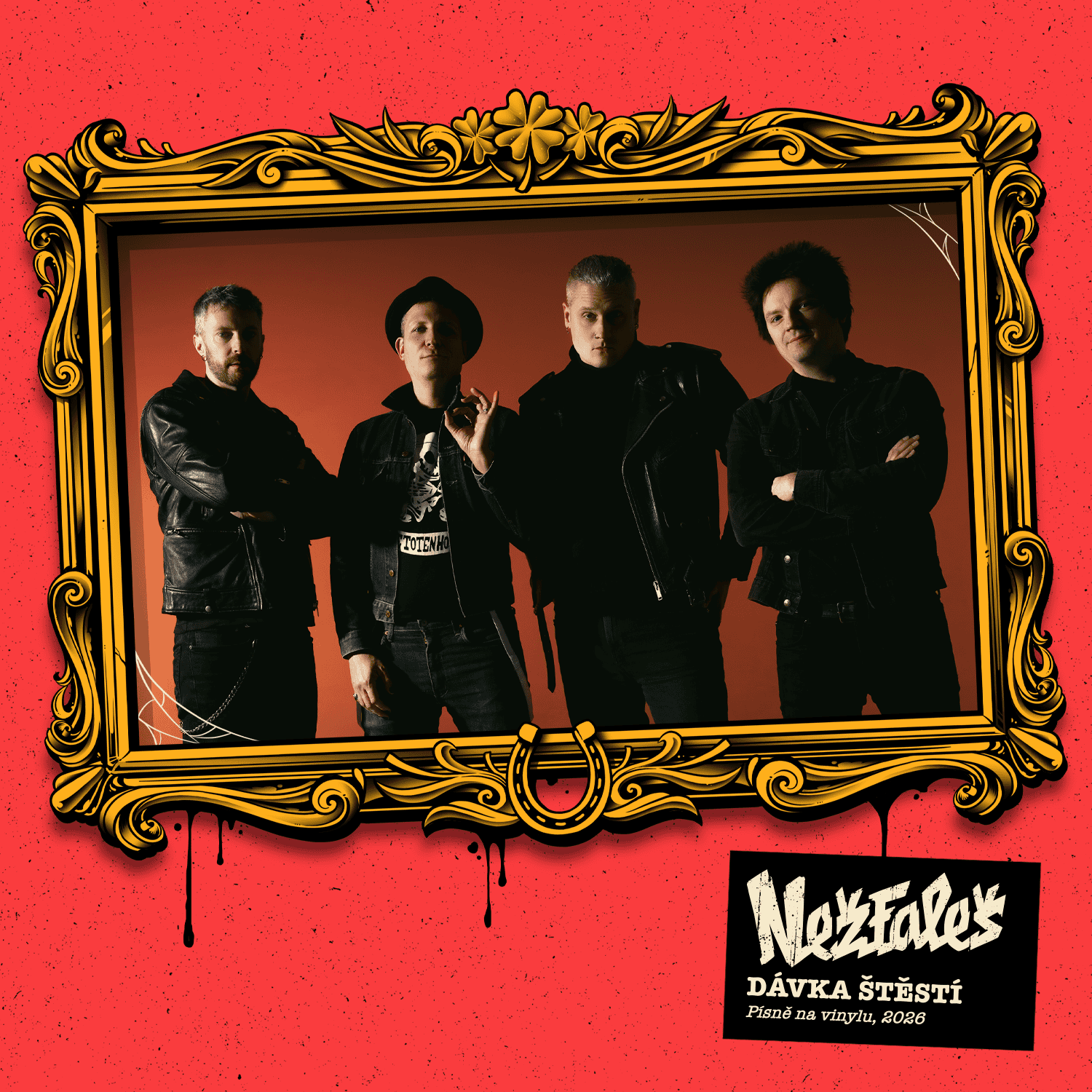
Dávka štěstí is the eighth, ninth, or quite possibly even the tenth full-length record by the Prague punk rock band Nežfaleš — depending on whether you count the split with Supertesla and the compilation Dvě desítky let among their regular albums. I’ll leave that up to you. What’s certain, however, is that in 24 years of existence Nežfaleš have become one of the most distinctive names on the Czech punk scene. They’re a band that never stops creating, touring, and releasing relevant records. They’ve crisscrossed the country so thoroughly you could probably play a “weekend spotting game” at gas stations across the country. At the same time, they became one of the key voices of the generation of bands that emerged around the year 2000.
Anyone expecting something groundbreaking will probably hit a wall here. But Nežfaleš deliver what they do best: melodic punk rock built on real-life themes, without unnecessary poses or grand gestures. The face and character of their music are shaped mainly by singer Radek’s multilayered lyrics. Those lyrics are exactly what set Nežfaleš apart from many of their genre peers in the Czech Republic. Hyperbole, irony, slightly biting sarcasm, but also the ability to precisely name things that affect us all — that’s the commodity that pushes the band a level higher. Musically, it’s well-played melodic punk rock with gang singalongs and a slightly poppy touch. Genre purists might shout that this isn’t “real punk,” and from their perspective they may have a point. But anyone putting on Nežfaleš is hardly expecting Black Flag to fuse with Dead Kennedys — we should be clear about that from the start.
The opener and title track Dávka štěstí is stylistically typical for the band and it’s hard to imagine a more characteristic introduction to the album. Alongside the music, a self-ironic story unfolds that fits into the mosaic of relationship tales frequently appearing in the band’s lyrics. It’s followed by Devadesátky, coming to terms with the childhood era of the generation the band represents. I’m not a big fan of nostalgic sentimentality about the past, but fortunately this song avoids cheap nostalgia — which is a plus. Third in line, Vyšehradští jezdci is an ultra-melodic tune with a strong chorus and gang vocals; I’d easily bet this will become one of their live hits. The band also shot a successful video for it paying tribute to the hooligans of the 1950s — boys for whom rock’n’roll and petty crime were more tempting than builder’s enthusiasm and love for the working people.
Sociální bublina is, at its core, a surprisingly political track: ironic, sarcastic, but sharp and actually a bit optimistic, because it reminds us how essential it is to have your people around you in turbulent times. A similar theme, but more cutting, is developed in Zlo je pořád zlo, one of the punkest moments on the album. Side A closes with the slightly melancholic Proč kazit příběh pravdou, built around a strong collective chorus.
Side B opens with Další Ramones nepřijdou, which nods to the playfulness of ’77 punk, leather jackets, and messy hair in the style of Ramones. Next comes the more straightforward Autopilot, where the roguishly tuned lyrics shine again. Rebel v županu (se vším se dá smířit) is a heavily ironic song targeting a peculiar Czech trait — the search for all kinds of crutches so that no one has to properly take a stand or, heaven forbid, stand by it afterward. The contrast between the almost poppy feel of this song’s chorus and its message strikes me as fantastic. Toward the end, the album toughens up and speeds up: that’s the case with Špatný já and Playback. The finale belongs to the melodic banger Bůh drží tankovací pistoli.
The band recorded the album in two phases — the first part in 2024, the second in 2025. Honestly, I can’t tell which songs were created when, because the record feels very cohesive. If this was a strategy to avoid an album with a few strong tracks and filler around them, it worked perfectly. With twelve songs, it shows in the solid overall result. The abundance of pop-cultural, literary, historical, and social references in the lyrics is also pleasing.
It’s also worth mentioning that the band released the album themselves. I support underground labels, but respect goes to any band strong enough to be self-sufficient. It’s one of the ways to keep the scene away from the mainstream rock machinery and maybe to motivate new bands as well. It might sound a bit idealistic, but this too is part of punk DNA. If this world is close to you, it makes sense to support Nežfaleš by buying a physical copy. In return, you’ll get a very good record.
TOP TRACKY: Rebel v županu (se vším se dá smířit), Vyšehradští Jezdci, Dávka štěstí