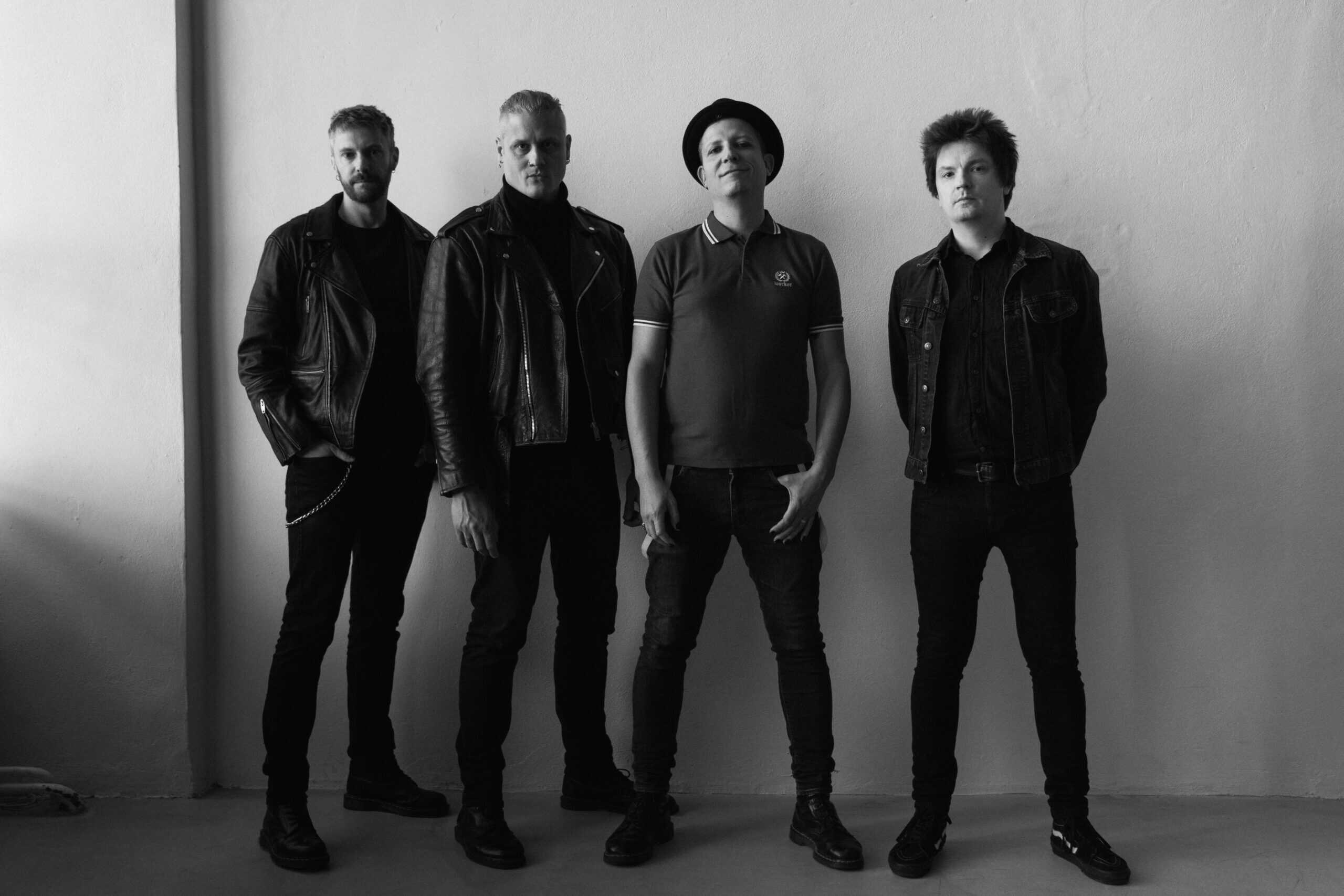
Nežfaleš is a band that has been active on the Czech punk scene for more than twenty years. After years of honest touring throughout the country, when the band has played almost every hall and pub where it is possible to drag a playing machine, the band has become an established and leading band in the Czech Republic. They are currently releasing a new album Dávka Štěstí, so we took the opportunity and arranged an interview with singer Radek.
It revolves around their long journey on the Czech punk scene, changes in the subculture, composing a new album and personal views on life, inspiration and aging in punk. It also openly touches on topics such as authenticity, relationships with fans, touring or the functioning of the band after more than two decades.

Nežfaleš have been around for 24 years – do you remember the moment you realized this wouldn’t just be a short punk episode but a long life journey? What crises did you face and how did you deal with them?
Hi, greetings to the readers of this great and erudite zine! I basically wanted to have a band since childhood; I don’t even remember what the first impulse was. Maybe the very first Czech issues of Bravo magazine, when it started coming out here – I was about 11. I bought it from the beginning and discovered the world of bands there; back then you’d regularly see Guns N’ Roses, Sepultura, or The Cure on its pages. I imagined what it would be like to live that life with rock’n’roll as your banner. I told myself that once I got a taste of it, it would be forever, so I never counted on a short episode. Of course, I could hardly have imagined we’d last this long and, I dare say, become one of the leading Czech bands in our genre. That belief that it would be a long life path and that you have to carve it out properly probably helped me get over the small band crises. We went through several lineup changes and even though they always shook me a bit, I told myself I couldn’t just quit. New members joined and we kept going, and the band kept gradually rising. I did fall into a personal crisis around 2015, which led to the band going on an indefinite hiatus. But the following year we slowly started playing again and it all led to the album Zločin z vášně (“Crime of Passion”), so as you can see, I didn’t last long without it. That’s when I maybe realized even more that it’s my fate to pull this cart as long as I can.
What’s harder about running a band after twenty years compared to the beginning – and what’s easier?
It’s actually two sides of the same coin. Because you already have something behind you – some successes and a larger base of supporters and fans – doors open more easily. You don’t have to try so hard to fill your concert calendar, you usually don’t have to convince anyone to let you play their club, and so on. That was much harder in the early days. But at the same time, because more people follow you, there’s also a certain pressure and uncertainty. Are we still good? Will we disappoint the people who told us our songs helped them through tough times? Will the new record meet the standard fans expect? Still, those are much nicer worries than wondering whether anyone cares about you at all.

You play almost every weekend and spend a lot of time traveling together. What still motivates you to pack up and go to another club, basement, or cultural hall? How hard is it to maintain relationships in the band when concerts become routine?
I’d push back a bit against the word “routine.” Sure, fewer things surprise you and you’ve played most places several times, but every show is still different and I still see them as experiences. Of course sometimes you don’t feel like it – personal issues, feeling unwell – but for me the band is like a higher force. I love the musician saying, half-jokingly: “The gig is sacred.” After all these years I totally understand why some people never want to leave the stage and why even bands past their prime still tour. Even huge bands that definitely don’t need the money anymore. It’s a cliché, but it’s a kind of drug and it’s very hard to quit after a while. Underground or mainstream, it doesn’t matter.
What has the band taken from you that people don’t talk about? And what has it given you that you couldn’t appreciate back then?
I don’t think the band really took anything from me. Maybe a bit of health – the lifestyle, especially earlier, wasn’t exactly exemplary. Some might say it takes a lot of time. Maybe seemingly, but what if you turn that time into something meaningful? How many people spend the same time lying on a couch watching nonsense on TV? I believe you can balance band, private life, and work – you just have to want to. And what did it give me? A lot. The feeling that something will remain after me. That I’m part of something that brings joy to many people and lets me express myself. It gave me many friends and acquaintances, and I even met my current wife thanks to the band. The positives definitely outweigh the negatives; I wouldn’t trade it.
Is Nežfaleš an escape from normal life, or its intensified mirror?
It’s not an escape; it’s part of my life. Given where the band is and how long I’ve done it, it’s naturally blended into my “normal” life. My wife used to travel with us selling merch and still helps a lot today with packing, shipping, and feedback. The boundaries blur – it’s coexistence rather than two separate worlds.
Do you play better technically today, and does it matter?
It would be bad if after all these shows and records we still played like naive kids. Experience pushes you forward whether you want it or not. We’re not instrument workhorses, but we know it should have a certain level. Authenticity and expression are just as important, maybe more. You can be technically brilliant, but if you’re not believable or can’t write a song, what’s the point? As a concertgoer I always expected some character and solid craftsmanship, and that’s what I want to deliver with Nežfaleš.
Where do you find inspiration today – music or life situations?
Mostly life situations, especially for lyrics. But I don’t really chase inspiration. Maybe it works subconsciously. I usually wait for a topic or slogan to fall into my lap. It takes longer these days, I admit, but if you keep your eyes and ears open, something grows eventually.
Does Prague still have its “dirt and romance,” or is it just scenery now?
I really like Prague, even though I’m no Prague-centric patriot. Of course it’s changing, like everything around us, and many cult places have already disappeared or ceased to exist. Our generation is lucky to have experienced those places in their former dirty-romantic shape and to carry them inside us. But I still enjoy walking through Prague today, and often — I think I know my hometown fairly well. Cities changing dynamically is probably natural, even if it doesn’t always feel like a change for the better. I feel a slight inner conflict about it myself. Was the old, pleasantly grimy dive bar better, or the modern brewery that replaced it, when I’m a fan of breweries myself? Is today’s version of Smíchov with its soulless cluster of shops better, or the formerly ultra-dirty Anděl crossroads where I was almost afraid to walk through as a kid? But if Prague is becoming just a backdrop, then I think it’s a damn well-made one. It still has its charm, like most cities shaped by history. You just might have to look a bit harder for it now.
Would Nežfaleš sound different if you came from a smaller town?
Without a doubt. The place where you have your roots will always be reflected in your work. That’s perfectly fine — it brings us back to authenticity. Many of my lyrics wouldn’t exist without Prague, or they’d simply be different. But I believe I could manage in a smaller town too. As I said, I’m no Prague-centric patriot; I just take Prague as the place where I happened to be born by coincidence. Maybe life in a small town would stir more social criticism in me, at the expense of songs about women and a bohemian lifestyle. Who knows.
Do you listen to punk differently today than you did twenty years ago? Do you still feel the need to discover new bands, or do you more often return to old records?
I think I still listen to it more or less the same. I’ve always preferred the more melodic side of punk, whether it’s the ’77 style or even the more modern American kind. Simple melodic songs, sometimes with a touch of classic rock ’n’ roll or melodic Oi!, rather than the more aggressive take on the genre. I’d rather celebrate life with a drink in hand than vent frustration and spit fire. I’m not much of a discoverer anymore either — unless someone really recommends something to me and it grabs me right away, I mostly stick to the old, proven records. There’s already so much I love that it’s more than enough for me.
Punk has always been connected to a lifestyle — what parts of it are non-negotiable for you today? And what aspects of the punk lifestyle are you consciously leaving behind?
Without a doubt, taking a stand against any form of oppression, racism, or homophobia is a given. But that’s really just basic common sense. The punk part is speaking out against it publicly and showing a certain level of activism. Still, I’ve seen more than once how some people used it as a convenient pose, so I always keep a bit of distance from that. I don’t feel the need to shout it from the rooftops — I think it’s clear enough which side we’re on. With age, the rough edges get smoothed out for almost everyone and in almost everything. The punk DIY ethos will probably always be close to my heart, as will the music itself and the whole visual side of it — the image, fashion, and graphics.
In your opinion, what makes the Czech scene specific compared to abroad — and in what ways do we unnecessarily throw obstacles in our own path?
It’s probably specific in the sense that a fairly active local scene and audience still exist here – including young people, which isn’t always a given abroad. I’m not entirely sure I have enough experience to assess it comprehensively, but from what I know, many foreign bands, when they come to the Czech Republic, praise the attendance at our concerts compared to neighboring countries. At the same time, unlike in some other parts of Europe, young people still attend punk shows here, and that’s crucial. It may mostly concern established bands, but even so, it’s great that this culture is alive here and hasn’t survived only as nostalgia.

Do you think it’s possible to live a punk lifestyle even without concerts, rehearsals, and clubs?
Absolutely. Punk shouldn’t have rules or conditions. You could theoretically run a philatelist club in a punk way.
What do you feel is missing on the Czech punk scene today, something that used to be taken for granted?
Your new album comes out in February – how does it differ from the previous ones in terms of emotions and themes? How does your current age and experience reflect in it?
The new album is always, for me, a snapshot of the band in its current state, creative possibilities, and present form. Simply put, this is Nežfaleš, 2026 edition—take it or leave it. I wouldn’t expect a huge difference with this record; it’s still very much us. Perhaps its tone is a bit sharper than our previous release, but I’ll leave that for the listeners to judge. Thematically, I wanted to step slightly away from the typical “loser” narratives this time (though they’re still there, of course), as evidenced by songs like Vyšehradští jezdci or Proč kazit příběh pravdou, both of which I really like. Almost from the first album, we’ve been confronted with the fact that our music is maturing. Since almost all of us are in our forties, it’s hardly surprising that this one is grown-up as well.
In what mindset or frame of mind was the new album created?
In a good one. The band is doing well, people are coming to shows, and since we didn’t want to completely wear ourselves out recording the album, we did it in two phases. Looking back, I think it was a great idea. You don’t have to wait until you’ve come up with all twelve tracks, when there’s always a risk that the oldest ones start to annoy you a bit. Plus, recording and mixing a whole batch of new music in one go, keeping focus, and doing the best work possible—it might not seem like much, but it’s really exhausting. This way, we comfortably put together half of it, went to record it without even knowing what would come out for the second half. But it was liberating to know that part of the work was already “under the roof.” The only minor issue was that each half was recorded in a different studio because the original studio had been demolished by the time we recorded the second half. However, the unifying factor was sound engineer and co-producer Honza Balcar, so we weren’t worried at all, and in the end, you can’t even tell which song came from which batch.
Are there moments on the new album that you wouldn’t have dared to write ten years ago? Is there anything on it that surprised even you?
I probably wouldn’t say I didn’t dare, but of course, after all these years you do struggle a bit with the feeling that you’ve already said everything. So you try to find ways to say it differently, in a fresh way. On every album, for example, I always want to include some kind of “lovesong,” and this time fate threw the real story of Anna Glässerová my way, and that was it. I don’t want to reveal more—the story can be looked up—but it’s a lovesong with depth. The role of some social critique, which I also try to include on almost every album, is fulfilled here by the track “Zlo je pořád zlo” (“Evil is Still Evil”)—the state of the world today is such that even Orwell or Čapek might be surprised. A somewhat unusual track is “Devadesátky” (“The Nineties”), which tries to capture the difference in perspective between someone who was about twenty at that wild time, experiencing all the parties with a sense of total freedom, and someone who also lived through the nineties but spent much of it, say, in elementary school. That iconic era left its mark on both, and I myself fall into the latter category.
What challenged you the most during its creation—and what did you actually enjoy?
It’s not that we were really struggling, but of course, it’s getting harder and harder to come up with the songs. Otherwise, there’s little in the studio that surprises us anymore. I even counted recently, and if you include various singles and such, we’ve been in the studio sixteen times already. As I mentioned, we recorded in two studios, and in the second one we started right at the end of its renovation—the first recording day the mixing console was still being hooked up. But thanks to Honza and Rosťa, there was no stress. Overall, I’d say what’s most enjoyable about recording is watching the songs gradually take shape, layering themselves with all the “meat” until they become the final product.
Do you tend to return to the past in your lyrics, or are you more interested in the present?
It’s about half and half. In the past, I probably called for the old times more in my lyrics. Once Martiček from the band Houba told me my lyrics were good, but sometimes I come across like an old grump. It goes hand in hand with the overall outlook on life. A few years ago, I decided I wouldn’t look back so much, but rather live in the present moment, with a slight glance toward the future, and I think that naturally reflected in my lyrics as well. I still enjoy a certain dose of nostalgia, both as a creator and as a listener.
Do you feel that fans expect something different from you today than they did ten years ago? What would you like listeners to take away from the new album?
The fans who have been growing older with us are now commonly dealing, in the best case, with starting families and weddings, and in the worse case, with divorces. But there’s also a sizable enclave of younger fans, for whom the main concerns are where to go for a weekend gig and what to drink. I believe that in our music, these two worlds have always been able to connect, and everyone can find their own thing in it. Bohemian life with depth—that’s perhaps how I’d define what I want people to take away from our albums.

Is it harder for you to write honestly today, or on the contrary easier than in your teenage years? Is it harder to maintain authenticity today than it used to be?
I’ve been trying to write honestly from the very beginning. I think listeners usually sense when someone is trying to make a fool out of them—unless it’s a deliberately adopted pose, of course. It’s true that I wrote quite a lot about drugs back when I didn’t really have much experience with them, but I guess they seemed sexier to me than beer. There was, of course, a bit of exaggeration in that. Writing honestly isn’t difficult. I think, on the contrary, pretending is harder—and I probably couldn’t keep that up for long.
I perceive your lyrics as intelligent, full of references to various cultural and social issues, rather than as a declaration of dissatisfaction with the political state of the world or frustration with it. How much, though, do personal mishaps, disappointments, or relationships seep into your lyrics?
There’s certainly some dissatisfaction and frustration in there as well. You’re right, though, I like to frequently use various pop culture references and such. That definitely doesn’t stop me from hiding a lot of my personal experiences, wisdom, relationship twists, and mishaps in the lyrics. It can be a bit misleading that I often write in the “you” form, addressing the listener directly with “you,” because it feels more urgent to me. Even so, the characters in my songs are largely fed by my own personal observations, experiences, and life events.
How do you know when a song is “finished” and not just a compromise?
It’s a question whether you can truly tell, but there are cases where you could tinker with a song endlessly, tearing it apart stone by stone, and it still might not improve it. We do a lot of filtering from the very beginning—if something doesn’t seem interesting enough, we might start it and then abandon it soon after. But what passes through that sieve, we try to finish to the best of our knowledge and conscience. Because of that, we basically have no unreleased material, since we only focus on what we see as having potential. You have to be aware that not everything has to be a hit. At the very least, it should be a dignified and well-crafted song.
Do you think more today when writing songs about how they will work live?
Not really; the songs usually speak for themselves. During the process, we kind of get a sense of what will work live and what we’ll include in the setlist, but we don’t make that the main focus. With eight albums under our belt plus some singles and splits, we have plenty to choose from in terms of repertoire. A live setlist obviously has to include a number of classics that people mainly expect, then there’s room to slot in a few songs we haven’t played in a while, which we like to do, and somewhere in there we squeeze in a new track or two. When one or two of the new songs eventually move into the classics section, you’ve won.
What drains you the most about being a musician today? And what still reliably recharges you?
In the long run, I don’t really have that urge anymore, but I love that feeling after a great gig, when you know you’ve done a good job, have maybe the next weekend off, and just let it sink in. Taking a break is necessary and totally fine, but that tug—when you start looking forward to playing again—hits all of us pretty quickly.
How has your relationship with punk changed between the time you were fifteen and today, when you’re all in your forties? Do you see rebellion as the main driving force in punk after forty, or is it more about staying true to yourself? Does punk still carry the same expressive weight past forty?
I think the saying “once a punk, always a punk” holds true—at least if you genuinely meant it and punk wasn’t just a momentary youthful recklessness or a programmed revolt for you. I’ve met people approaching fifty who you’d never guess were punks, but deep down they were the truest punks around. For me, I’ve always valued punk music and style more than rebellion or activism. That kind of thing can easily slip into what it’s fighting against, tying itself up in rules and ultimately consuming itself. The magic of punk, for me, is that it’s whatever you make of it inside yourself. In my take on punk, there’s not much difference between my fifteen-year-old self and my forty-year-old self.
What can bring you the most joy at a concert today, even when something goes wrong?
I try not to get worked up anymore. Unfortunately, the current political situation doesn’t make that easy. I basically didn’t follow politics before, but this absurdist state nowadays simply can’t be ignored. People like Jindřich Rajchl make me feel physically sick. It’s not even about getting angry—it’s just that it literally makes your stomach turn.
How do you cope with the fact that, for some younger fans, you’re already considered an “old band”? Do you feel there’s new blood in the scene, or do you think the audience is just aging with you and subcultures no longer draw people in?
That’s just how it is. Every band that lasts long enough will eventually be considered “old.” I don’t see it negatively, though—we operate in a world where bands a generation older than us, the ones we grew up with, are still active. On top of that, “old bands” like ours still draw great crowds, so we really can’t complain. Fortunately, the aging of the audience has reversed a bit over the past few years, and young people have started showing up again, which makes me happy. There are even finally a few young bands popping up, although for now mostly local—but that’s always how it goes. There was a period when it looked pretty bleak; we looked around for a pumped-up young crew to back us up, and there was nobody there. These young bands need to carry the banner of this subculture forward. We can’t really do it anymore, especially since bands of our generation now attract a lot of mainstream audiences.
I see Nežfaleš as a band that operates in the underground, but thanks to an intense and long-term live career, you’ve managed to play at many events that aren’t strictly underground by nature—typically, style-blended summer festivals where genres mix and different bands meet. My questions are based on the idea that you have a better vantage point on certain topics that purely underground bands usually don’t. I’m curious how you see the chances for new punk/rock bands to break through today, and what approach they should take. Twenty years ago, the coveted milestones were getting a song on a small rock radio station, opening for an interesting band, or releasing a music video. The internet, social media, and accessible technology that makes producing a music video possible—these things have completely changed the rules of the game. How do you perceive this broad question?
Well, I’ll tell you—I really wouldn’t envy starting bands today. Social media or the ability to record a decent track pretty much at home in your room is great, of course, but it also creates tons and tons of pseudo-artists, and the whole scene becomes confusing and blurry. The internet is overloaded; suddenly everyone is a creator, and the islands of good music with real potential often get completely lost in all the clutter. With so much online, the advantages bands had when YouTube or social media first arrived are now fading. When we started, the internet was a privilege of the few, and you had to do things the old way. Myspace was still lurking around the corner, and we just kept touring, often playing shows with attendance like a sound engineer, a bartender, and five stragglers. Nobody would do that today. Now, you post a clip online, wait, and then get frustrated that no one noticed your genius and you’re not opening your first gig in the O2 Arena. I’m exaggerating a bit, but not that much. Young bands today often lack humility. We used to play for free, subsidize the band ourselves, and even travel expenses were often above the plan. Nowadays, a band from the next town will flat out say, “We’re not even leaving the couch for 3,000 CZK, let alone drive 10 km to a decent show.” They’ve got the clip on YouTube, and the singer’s girlfriend says they don’t need to bother. I see it as bands having it tougher today in some ways than when we started, but we also had it harder than the bands starting in the early ’90s, when someone would basically release your record right away and you just had to handle it well. My advice to today’s starting bands would be our path: play and play. Even just for travel expenses. Social media is important as a tool, but real contact with the audience still seems like the most honest and proper way.
What can bring you the most joy at a concert today, even when something goes wrong?
Of course, the feedback from the audience is always a highlight, and definitely having a skilled, willing sound engineer makes a huge difference. Recently, we had a weekend that illustrated this perfectly: on Friday, the sound guy was miserable, disinterested, doing only the bare minimum, and you felt like you were practically bothering him. He didn’t care at all that there were 200 people in the club. The next day, we were lucky to have a relaxed, easygoing guy at the board—nothing was a problem, and with just a flick of his fingers, he produced an amazing sound. Sound engineers are a story of their own, but when it comes to this second one, we just say: more of this, please, and with bigger doses!

How has your relationship with alcohol changed in connection with playing live?
You just caught me in a phase where I’m generally cutting back on alcohol a bit. For me, it’s mainly a fondness for craft beer, but lately I’ve noticed that it doesn’t sit as well with me anymore. I might temporarily abandon my old theory that it’s best to drink lightly but continuously and take a few breaks instead. You’re probably mostly curious whether we ever fall down drunk on stage or do other fun stunts. Over the years, of course, there have been a few excesses, but nowadays it’s really not desirable to stumble around in front of a packed club, grab the pay, and drive off. Everyone in the band understands that it has to be a bit professional now, and we owe the audience—those who paid—to deliver a proper performance. That’s the right approach; I wouldn’t want to pay for a ticket and see a bunch of drunk idiots. Gone are the days when I’d drink a whole bottle of wine in the hour-long drive to a gig. Now, two beers before the show are optimal for me, and I often don’t drink at all on the ride in the van. That said, I admit that performing completely sober doesn’t feel right either, so I try to avoid that.
If someone asked you today who Nežfaleš really are, what would you answer—without posing or using slogans?
Four guys brought together by the music they make. And who, when they find the time, can still just go out for a beer together.
What I’d miss most if Nežfaleš ended tomorrow? Definitely the music itself, the experience of playing it, and the whole shared journey with the guys—both on stage and just hanging out.
Probably the daily connection with this subculture—the friends, the gigs. There are things I could live without, like shooting music videos, but live shows are still the most important thing for me.
The last words are yours. Is there anything you’d like to say that I didn’t ask about? Your moment.
I’d just like to wish everyone, in these turbulent times, to keep their common sense and perspective. And when things piss them off that they can hardly influence, I hope they start with themselves and live life on their own terms—because that’s something they can move. If our new album helps with that even a little, we’ll be more than happy! We’re looking forward to seeing everyone at the shows, and I’d especially like to invite everyone to the big spring tour alongside Totální nasazení and The Fialky, where we’ll, of course, bring the new album Dávka štěstí, celebrate it, and share all the experiences that go along with it!
And thank you for the interview!
Discography:
Jak za války CD (DIY, 2005)
Není čas na hrdinství CD (DIY, 2006)
Ber dokud dávám CD (Cecek Records, 2008)
Pár lacinejch triků CD (Cecek Records, 2010)
Každej klub i bar CD (Cecek Records, 2012)
Split w. SPS EP (Cecek Records, 2014)
Zločin z vášně LP (Cecek Rercods, 2017)
Split w. Supertesla LP (Cecek Records, 2018)
Šminky padlejch královen LP (Cecek Records, 2021)
Dvě desítky let LP (Cecek Records, 2022)
WEB: https://www.nezfales.cz/
INSTAGRAM: https://1url.cz/meMFx
FACEBOOK: https://1url.cz/8uZvE